
Vehicles
A vehicle carries goods over real roads. It has a home site, takes one garage slot there and drives the route you give it. Its popup on the map names the home site as a link, and its dialog starts at that site. The game has 27 vehicle types in 8 classes. Vehicle types lists each with its numbers.
The six numbers of a type
Section titled The six numbers of a type| Number | What it means |
|---|---|
| Capacity | The most a vehicle carries, in t. |
| Speed | How fast it drives on a country road. A trip takes the drive time of a car on that road, stretched by the type. |
| Handling | The time it needs at each stop to load or unload. |
| Cost per km | The operating cost, charged when a trip ends. |
| Upkeep | What it costs per hour for being owned, charged for 24 hours at each settlement, multiplied by your overhead. |
| Price | What it costs new. |
The numbers of a type never change. A vehicle you bought stays what it was.
Classes and patterns
Section titled Classes and patternsThe cargo vehicles come in classes by size: pickup, van, truck, road train. Inside a class the types trade one number for another. The class car holds the taxis, the vehicles that carry passengers.
| Pattern | Gives | Takes | Pays off when |
|---|---|---|---|
| Budget | a low price | capacity, pace, cost per km | cash is short |
| Standard | the baseline of its class | always a fair choice | |
| Flatbed, long, heavy | more tons per trip | pace and handling | the drive is long and the market takes the tons |
| Express, tipper | a faster pace or quick handling | upkeep | the route is short with many stops |
| Electric | a low cost per km | price | the vehicle drives far every day |
A larger vehicle earns more per trip and waits longer for its load. On a farm that grows 4.0 t per hour, a truck of 20 t waits hours for a full load. Match the vehicle to what its sites make.
What carries what
Section titled What carries whatEvery cargo vehicle has one body, and every good names the bodies that carry it. A vehicle loads a good only when its body is one of them, so a van cannot take gravel and only a refrigerated vehicle takes cheese. Freight jobs are box goods. A vehicle that still holds cargo its body does not carry unloads and sells it as before.
| Good | Box body | Tipper | Tank | Refrigerated |
|---|---|---|---|---|
 Grain | Yes | Yes | ||
 Flour | Yes | |||
 Logs | Yes | |||
 Planks | Yes | |||
 Bread | Yes | Yes | ||
 Milk | Yes | Yes | ||
 Wine | Yes | Yes | ||
 Gravel | Yes | |||
 Sand | Yes | |||
 Machine parts | Yes | |||
 Furniture | Yes | |||
 Coffee | Yes | |||
 Cocoa | Yes | |||
 Electronics | Yes | |||
 Fuel | Yes | |||
 Fertilizer | Yes | Yes | ||
 Coal | Yes | |||
 Iron ore | Yes | |||
 Steel | Yes | |||
 Chocolate | Yes | |||
 Instruments | Yes | |||
 Hops | Yes | |||
 Beer | Yes | Yes | ||
 Cheese | Yes | |||
 Potatoes | Yes | Yes | ||
 Rapeseed | Yes | Yes | ||
 Sugar beets | Yes | Yes |
Box body: Budget pickup, Pickup, Flatbed pickup, Electric pickup, Budget van, Van, Long van, Express van, Electric van, Budget truck, Truck, Heavy truck, Express truck, Road train.
Tipper: Tipper van, Tipper truck, Tipper road train.
Tank: Tanker van.
Refrigerated: Refrigerated van.
Buying
Section titled BuyingYou buy a vehicle for one of your sites with a free garage slot that parks its category. Every type belongs to a category: cargo vehicles carry goods and freight, person vehicles carry passengers and construction vehicles carry nothing and work at construction jobs. The  taxi, the
 budget taxi, the
 electric taxi, the
 taxi van and the
 executive taxi are the person vehicles. The
 excavator, the
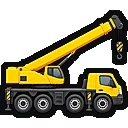 mobile crane and the
 concrete mixer are the construction vehicles, the machines of the construction jobs; they carry nothing, so their cards show no capacity and no cargo. Every other type is a cargo vehicle. A depot parks all three categories, a farm or a quarry parks cargo and construction vehicles, and a maintenance company or a construction company parks machines. Vehicles you bought earlier stay where they are, also where their site would not park them now. Every type is offered new and used.
- New costs the price of the type.
- Used costs 60% of it. Its service is due 2 times as often, and the bank pays less for it later.
The list shows each type as a card with its picture, its name, its price and three chips: capacity, speed and upkeep. Tap a chip to read what it means, and tap the picture to open the full stats and the buttons that buy it new or used.
A bought vehicle takes time to arrive. A used vehicle comes in half the time.
| Type | New | Used |
|---|---|---|
 budget pickup | 10 min | 5 min |
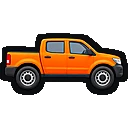 pickup | 15 min | 8 min |
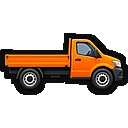 flatbed pickup | 20 min | 10 min |
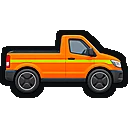 electric pickup | 25 min | 13 min |
 budget van | 20 min | 10 min |
 van | 30 min | 15 min |
 long van | 40 min | 20 min |
 express van | 45 min | 23 min |
 tanker van | 1 h | 30 min |
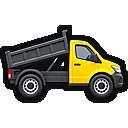 tipper van | 45 min | 23 min |
 refrigerated van | 1 h | 30 min |
 electric van | 1 h | 30 min |
 budget truck | 1 h 30 min | 45 min |
 truck | 2 h | 1 h |
 tipper truck | 6 h | 3 h |
 heavy truck | 8 h | 4 h |
 express truck | 10 h | 5 h |
 road train | 12 h | 6 h |
 tipper road train | 16 h | 8 h |
| taxi | 15 min | 8 min |
| budget taxi | 15 min | 8 min |
| electric taxi | 20 min | 10 min |
| taxi van | 30 min | 15 min |
| executive taxi | 45 min | 23 min |
| excavator | 4 h | 2 h |
| mobile crane | 8 h | 4 h |
| concrete mixer | 2 h | 1 h |
The buy dialog shows the time under each price, and the vehicle shows "Arrives in" with a countdown until it is there. You can give it a route at once; its first trip starts on arrival. A vehicle bought for a site that is still under construction arrives when the site is ready, if that is later, and arrives sooner when the site is sped up. The first 2 you buy arrive in 10 seconds.
A new vehicle gets a German number plate as its name, such as HM-HH 412: the district code of the town of its home site, one or two letters of your company name and a number from 1 to 999. No two vehicles of your company share a plate. Vehicles bought before 14 October 2026 keep names such as Pickup 2. Rename a vehicle with the pencil on its card or in its dialog, for example to group your fleet as "Farm 1 grain" or "Rush". A vehicle name follows the same rules as a site name, and two vehicles may share one.
Moving the home
Section titled Moving the homeWhen you send a vehicle to one of your sites, you can also move its home there. The site must park the category of the vehicle and have a free garage slot. The slot is yours from that moment and the old one is free at once. The vehicle drives there as it does for any send, and the night factors of the new home apply from its next trip. A site that is full or does not park the category shows why in the list.
Wear and service
Section titled Wear and serviceA vehicle needs a service every 5,000 km, a used one every 2,500 km. An overdue vehicle plans its trips 25% longer. An alert names a vehicle that needs service. A vehicle that is due shows a Service button with the price over it on the map; one tap services it, and a wrench badge marks it when you zoom far out. The Service tile on the Overview and on the "Since you left" card shows how many vehicles it services and what that costs together, and services every due vehicle your cash covers; it says how many it skipped for lack of cash. A Service lead lowers the price everywhere it is shown. When cash is short, the Service button rests and says how much is missing.
A service costs €240 at the garages of the town, or €40 when your company owns a workshop.
Selling
Section titled SellingThe bank buys a vehicle back for 50% of its price while it stands at a stop or is parked, also while it loads or holds cargo. Its cargo is lost with the sale, and the button says so. A vehicle on the road is sold after it arrives.
What research changes
Section titled What research changes| Node | Effect on every vehicle you own |
|---|---|
| Quick hands | handling -15% |
| Eco driving | operating cost per km -15% |
| Lean fleet | upkeep -20% |
| Fleet care | a service every 7,500 km |
| Trade in | the bank pays 60% of the price |
See also
Section titled See also- Routes and trips for what a vehicle does all day.
- Day, night and upgrades for trips at night.
- Sites for garage slots.